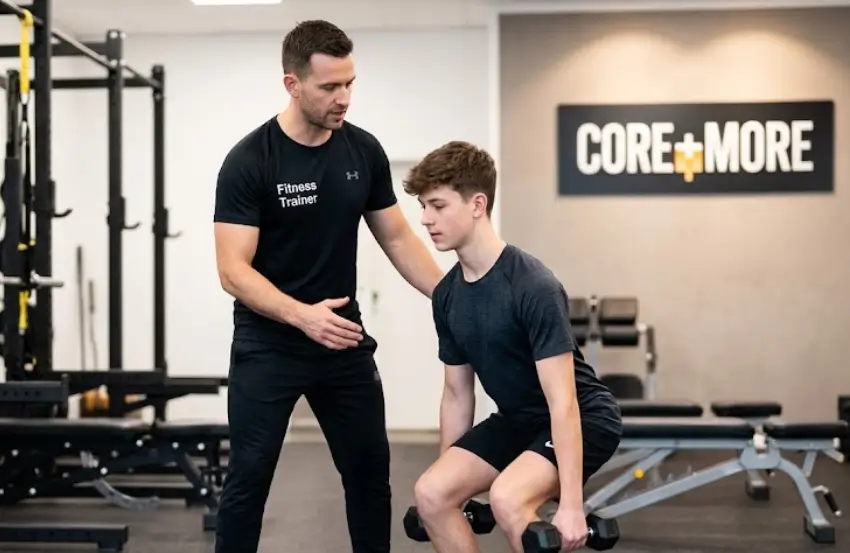

When enquiring about coaching at Core and More Fitness in Clapham, most people face a choice between one-on-one sessions and two-on-one sessions (training with a partner). Both formats work — but they work differently, and the right choice depends on your goals, preferences, and budget.
What Is 1-on-1 Training?
In a one-on-one session, it’s you and your coach. The entire session is built around your specific goals, your technique, your energy on that day. There are no compromises. Rest periods, exercise selection, load progression — everything is calibrated to you alone.
One-on-one training is the highest level of personalisation available. It’s the format we recommend for clients with specific injury rehabilitation needs, complex goals requiring frequent programming changes, or those who simply prefer undivided attention.
What Is 2-on-1 Training?
Two-on-one training pairs you with one other person — typically a friend, partner, or colleague — under one coach. Sessions are designed to work for both of you simultaneously. While one person performs an exercise, the other rests or works on a complementary movement.
This format works remarkably well when the two participants are at similar fitness levels and have broadly compatible goals. It introduces a social element that many clients find motivating — and splits the coaching cost between two people.
Key Differences
Cost
Two-on-one training reduces the per-person cost significantly. For clients where budget is a consideration, training with a friend in a 2-on-1 format allows access to quality coaching at a more accessible price point.
Attention and Personalisation
One-on-one training offers more coaching attention per minute. In a 2-on-1 session, your coach is dividing their attention between two people — meaning technique feedback may be slightly less immediate. This is manageable for experienced movers but more relevant for beginners.
Motivation
Most people train harder with a partner present. The social facilitation effect — the performance boost from being observed — is well-documented. If you’re the type who needs external motivation, 2-on-1 may actually get you better results than 1-on-1.
Programme Flexibility
In one-on-one sessions, your programme can change on the day based on how you feel, what your coach observes, and any new goals or constraints. In 2-on-1, the programme needs to work for both participants — which means slightly less individual flexibility.
Our Recommendation
If you’re a beginner with specific goals or injury history — start 1-on-1. If you have a friend or partner at a similar level who wants to train alongside you — 2-on-1 is excellent value and highly effective.
Get in touch at Core and More Fitness to discuss which format suits you.